
The harness is the part of a strap-on setup most people think about last, and the part that decides whether the whole thing feels secure or frustrating. A good toy in the wrong harness droops, wobbles and slips. An average toy in a harness that fits feels stable, controllable and comfortable enough that you stop thinking about it.
This guide compares the common strap-on harness styles – two-strap (jockstrap style), single-strap (thong style), underwear harnesses, thigh harnesses and the strapless alternative – and explains the details that decide how well any of them works for you: ring size and material, the shape of the toy’s base, sizing, materials and care. The ratings below describe how each style typically performs. A well-made harness of one type can easily beat a poorly made one of another, so use them as a starting point, not a rule.
Short answer
- First time? An underwear (brief/boxer) harness is the simplest start. An adjustable two-strap harness is the most versatile one.
- Stability and control: two-strap harnesses usually give the most, as long as the ring fits the toy snugly.
- A firm, simple fit: a single-strap (thong) harness – if the centre strap suits you.
- Soft and easy to wear: an underwear harness, often the choice for people who prefer fabric to straps.
- Riding positions, or when a hip harness doesn’t suit your body: a thigh harness.
- No harness at all: a strapless strapon – a different system with its own learning curve.
Whatever you choose, check that the harness and the toy are compatible before you buy. Ring size, ring material and the shape of the toy’s base matter as much as the harness style.
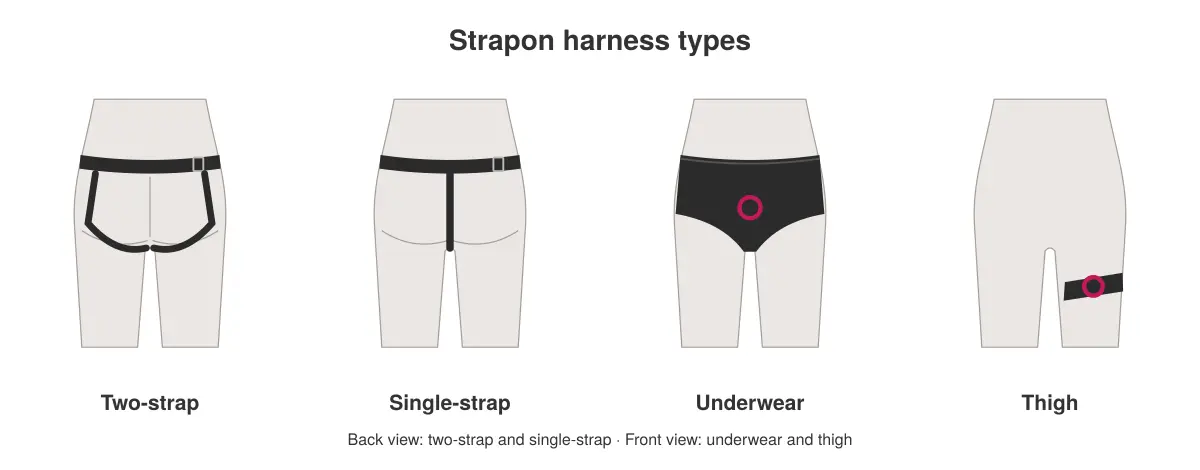
Strap-on harness types at a glance
| Type | How it holds | Typical stability | Wearer comfort | Fit range | Beginner-friendly | Swappable O-ring | Vibe pocket | Care |
|---|---|---|---|---|---|---|---|---|
| Two-strap (jockstrap) | Waistband + two straps under the buttocks | High | Often comfortable – nothing between the cheeks | Wide (buckles, D-rings, elastic) | Easy after the first setup | Often | Sometimes | Depends on material |
| Single-strap (thong / G-string) | Waistband + one strap between the legs and up the back | Medium–high | Depends on the person – some like the centre strap, others find it rubs | Wide (adjustable) | Easy | Sometimes | Rarely | Depends on material |
| Underwear (brief / boxer) | Stretch fabric briefs with a built-in ring | Medium – depends on fabric and toy weight | Often soft and easy to wear for long periods | Sized (S–XL and up), less adjustable | Very easy | Varies – often sewn in, some sold in several ring sizes | Often | Usually machine washable |
| Thigh harness | Strap around one thigh with a ring on top | High in riding positions, low for thrusting | Usually comfortable | Adjustable | Easy, for riding positions only | Often | Rarely | Depends on material |
| Strapless (no harness) | Internal bulb held by the wearer’s own muscles | Low | Varies a lot from body to body | Not adjustable | Takes practice | – | Some models vibrate | Toy only |
How a strap-on harness works
Most harnesses work the same way: a ring (the O-ring) or an opening sits over the pubic bone, and a toy with a flared base is pushed through it from behind. The base is wider than the ring, so the ring holds it in place, and the straps or fabric press the base against the body. Everything else – straps, buckles, padding, fabric – exists to keep that ring in the right place and the base pressed firmly enough that the toy doesn’t wobble.
That gives you three things to judge any harness on:
- Where the ring sits – on or just above the pubic bone, not low between the legs.
- How snugly the ring holds the toy – the shaft just above the base should fill the ring without being forced.
- How firmly the base is pressed against the body – that’s the job of the straps or fabric, and where harness styles differ most.
Stability is never the harness alone. The width of the waistband and straps, the quality of the buckles, how stiff the front panel is, and the toy’s length, weight and flexibility all play a part – and so does how well the harness fits your body.

Two-strap harness (jockstrap style)
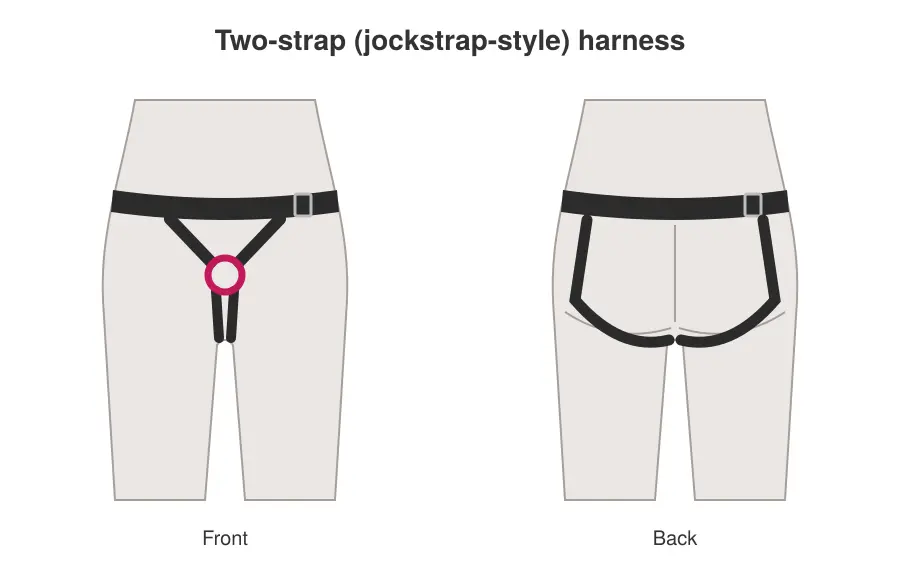
The two-strap harness is the most common and the most versatile design. A waistband holds the ring at the front, and two separate straps run from the bottom of the ring, under the buttocks and back up to the waistband – like the leg straps on a jockstrap. The middle stays open.
Why people choose it
- Stability: two anchor points pull the base evenly back against the body, so the toy tends to stay pointing where you aim it.
- Comfort: nothing runs between the buttocks, which many wearers prefer for longer sessions.
- Access: the wearer’s own body stays accessible – useful for extra stimulation or a double-ended toy.
- Fit: buckles and D-rings let one harness fit a wide range of hips, and each strap can be tightened on its own.
Downsides
- More straps means more to adjust the first few times.
- Cheap versions with thin straps or plastic clips can twist, dig in or come loose.
- The leg straps need to sit right – too low and they slide down the thighs, too high and they pinch.
Good fit for: people who want control and adjustability, who will use toys of different sizes, or who will share the harness between bodies.
Single-strap harness (thong or G-string style)
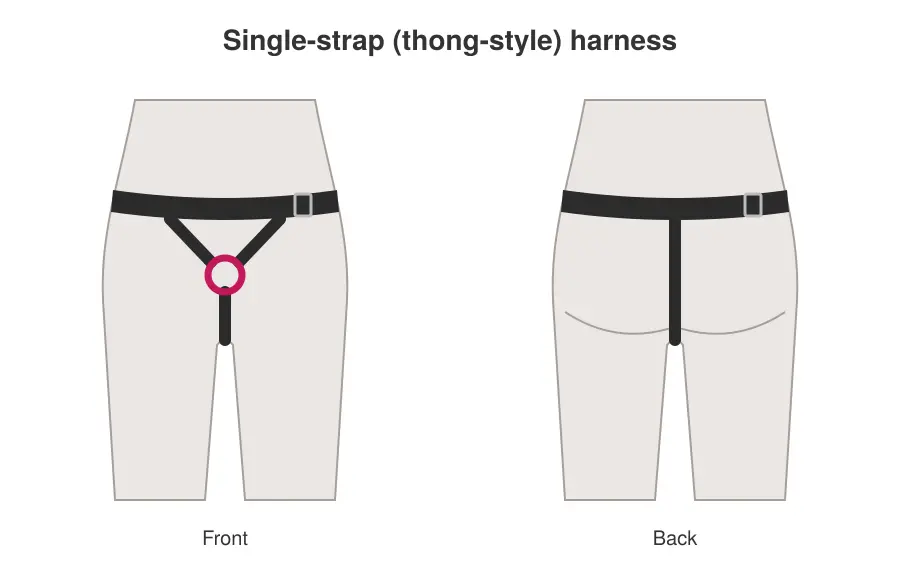
The single-strap harness replaces the two leg straps with one strap that runs from the bottom of the ring, between the legs and up to the waistband at the back – like a thong. It’s the classic design many people picture when they hear the word harness.
Why people choose it
- Direct hold: the centre strap pulls the base straight back, which can give a close, firm fit when tightened.
- Simple: fewer straps to adjust.
- Sensation: some wearers enjoy the pressure of the centre strap.
Downsides
- The centre strap can rub over time – the most common reason people switch to a two-strap design.
- It covers the wearer’s own body, leaving less access for their pleasure.
- With a single rear anchor, the toy can tilt sideways more easily – although a wide strap and a stiff front panel reduce this a lot.
Good fit for: wearers who like the feeling of a centre strap and want a firm, uncomplicated fit.
Underwear harness (brief or boxer style)
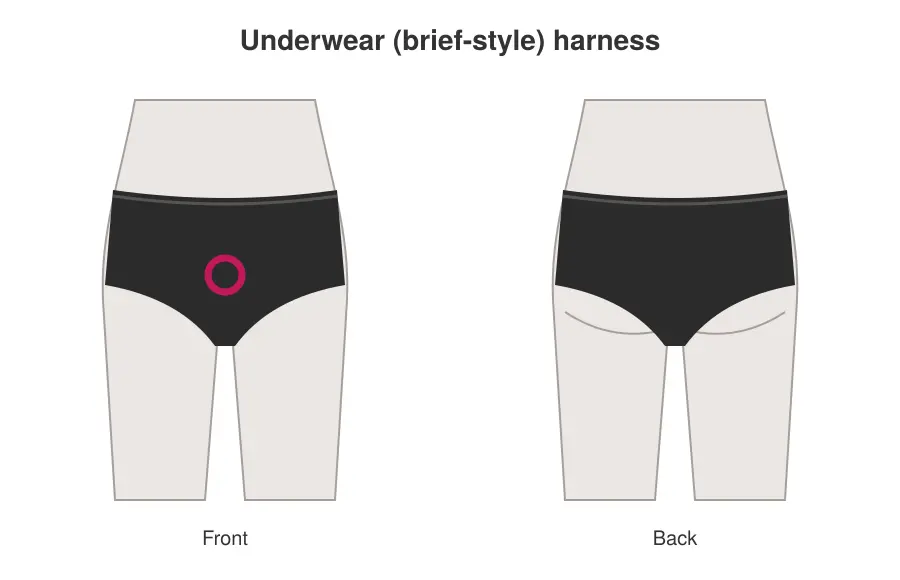
Underwear harnesses look and feel like ordinary briefs or boxer briefs, with a ring or opening sewn in at the front. Most are cotton or nylon blended with spandex, often double-layered at the front for support. You step into them like underwear, push the toy through and you’re ready.
Why people choose it
- Easy to use: no buckles and nothing to adjust – a natural first harness.
- Soft to wear: fabric spreads the pressure, so many people find it easy to wear for a long time.
- Extras: many models have one or two pockets for a small bullet vibrator, above or below the ring.
- Easy care and discreet: most can go in the washing machine, and they look like underwear when there’s no toy in them. That also makes them popular for packing.
Downsides
- Stability depends on fabric and toy: stretch fabric gives, so heavy, long or thick toys can droop or bounce. Wider waistbands and double-layered fronts help.
- Sizing matters more: it comes in fixed sizes, so the fit depends on choosing the right one, and it’s harder to share between very different bodies.
- Ring choice is decided at purchase: the ring is usually sewn in. Some ranges are sold with different ring sizes, so pick the one that matches your toy.
Good fit for: beginners, small to medium toys, people who prefer fabric to straps, and anyone who values simplicity.
Thigh harness

A thigh harness is a wide strap that wraps around one thigh, with a ring on top. It isn’t a replacement for a hip harness – it’s a different tool for different positions.
Why people choose it
- Riding positions: the partner sits on or straddles the thigh and controls pace and depth.
- Less hip movement needed: useful when a hip harness doesn’t sit well on someone’s body, or when the wearer has limited mobility or energy for thrusting.
- Hands and hips free: the wearer can focus on other things at the same time.
Downsides
- Not suited to classic thrusting positions.
- The strap must be tight enough not to rotate around the leg – but not so tight that it’s uncomfortable.
See it in use: a thigh harness is worn in this real couple video.
Good fit for: partners who like to be on top and in control, and as a second harness alongside a hip harness.
The strapless option (no harness)
A strapless strap-on has a bulb at one end that the wearer holds inside their own body, so no harness is needed. It feels closer and more direct, and both partners get stimulation at the same time. The trade-off is hold: the toy stays in place through the wearer’s own muscles, so it takes practice, works better in some positions than others and varies a lot from body to body. Some people add snug underwear or a harness for extra support.
Other harness variants worth knowing
Not everything fits neatly into the styles above. It helps to separate three things: the harness (what you wear), the attachment system (how the toy is held) and the toy itself. These variants mix them in different ways:
- Hollow strap-ons and extenders: a hollow shaft worn over a penis, either with its own straps or in a harness. Used for extra size, for erection difficulties, or simply as part of play.
- Double-ring harnesses: two rings, one above the other, for double penetration.
- Plug systems such as Vac-U-Lock: instead of a ring, the harness has a plug and the toy has a matching hollow base that slides onto it. These toys don’t fit a normal O-ring, and normal toys don’t fit the plug – a common source of confusion with cheaper kits. Some of these harnesses also come with rings.
- Double-ended toys: one end goes inside the wearer, the other through the ring. They need a harness that leaves room behind the ring for the internal end – most two-strap and many underwear designs do.
- Ride-on cushions and mounts: a firm cushion or mount with a ring or suction base, so a partner can ride without anyone wearing anything. A good alternative when mobility is limited.
Ring and base compatibility
Most harness problems are really compatibility problems. Before blaming the harness, check these four things.
Ring size
The shaft just above the base should fill the ring snugly. A ring that’s too big lets the toy wobble and droop; one that’s too small makes the toy hard to insert and pushes the base away from the body. Many rings are around 1.5–2 inches (roughly 4–5 cm) in inner diameter, but these are typical sizes, not a standard. Check the maker’s stated ring diameter against the toy’s diameter just above the base. Firmness matters too: a soft silicone toy can squeeze through a ring that holds a firmer toy of the same diameter securely, so check the fit with the actual toy you’ll use.
Ring material
- Metal rings are stiff and hold heavy toys well, but can press on the pubic bone and only fit a narrow range of shaft sizes. Look for nickel-free hardware if you react to nickel.
- Silicone and rubber rings stretch, so they’re more forgiving across toy sizes and more comfortable. With heavy toys they give more.
- Swappable rings (on snaps or screws) let you change size as you change toys. Spare rings are sold separately if your harness only came with one (see Autostraddle’s harness guide for more on rings and adjustments).
Base width
The base must be clearly wider than the ring. Compare the maker’s ring size with the toy’s base first. Then fit the toy from behind with normal hand pressure – don’t force it. If the base slips through with ordinary handling, it will slip during use. Fitted correctly, the toy goes in without excessive force, the base stays behind the ring, and the toy doesn’t spin or rock freely.
Base shape and angle
The direction a toy points is decided largely by the toy, not the harness. Flat bases point the toy straight out. Some bases are angled, and some shafts are curved, which helps the toy point slightly upward – often what you want for pegging and G-spot play. No harness can correct a base that points the wrong way. Bases with large or thick suction cups can work as flat bases, but they may press uncomfortably, push the ring forward or make the toy point down.
How to choose the right harness
Work through these questions. The answers usually narrow it down to one or two styles.
- Is this your first harness? An underwear harness keeps things simple. An adjustable two-strap harness gives more control from day one.
- How heavy is the toy? Heavier and longer toys need firm support: straps, a snug ring and a stiff front. Light, small toys work in almost any style.
- Will you use toys of different sizes? Choose swappable rings or a stretchy silicone ring, not a fixed narrow opening.
- How much do you want to adjust? Straps can be fine-tuned; underwear can’t. If your body is between standard sizes, adjustability matters more.
- Will more than one person wear it? An adjustable, washable harness – or one each, especially with leather.
- Does the wearer want stimulation too? Look for an open back, a vibe pocket or a double-ended toy.
- Does a hip harness not suit your body, or does your partner want to be in control? Add a thigh harness or a ride-on cushion.
Fit and sizing
Measure where it will sit
Most harnesses sit lower than your natural waist – around the hip bones. Measure there and compare with the maker’s size chart and adjustment range. Check whether the waistband, leg straps and front panel can be adjusted separately. Don’t automatically size down for stability: a harness should hold firmly without pinching, chafing or limiting movement. Extender straps are available for many buckle-and-D-ring harnesses, and several makers offer plus sizes.
Put it on in the right order
- Loosen all straps and insert the toy through the ring before putting the harness on – it’s much easier.
- Step in and place the ring on or just above the pubic bone.
- Tighten the waistband first, so the ring stays at the right height.
- Then tighten the rear strap or straps until the base presses firmly against the body.
- Check the angle and adjust – if the toy still points down, see the troubleshooting table below.
Stabilisers and padding
A foam or silicone stabiliser ring between the base and the body adds support for small or flexible bases and cushions the pubic bone. Some harnesses have a padded or stiffened front panel for the same reason. Both can make a harness feel more stable, but they can’t fix a ring that’s the wrong size or a harness that doesn’t fit.
Harness materials compared
| Material | Strengths | Weaknesses | Care |
|---|---|---|---|
| Leather | Very sturdy, moulds to the body over time | Absorbs fluids, can’t be fully disinfected, heavier | Wipe clean, condition, air dry – never machine wash |
| Vegan / faux leather (PU) | Leather look without animal products, wipes clean when new | Less breathable; once it cracks, it becomes harder to keep clean | Wipe with mild soap and water |
| Nylon webbing | Strong, light, affordable, washable | Edges can rub on bare skin | Hand or machine wash (check label), air dry |
| Neoprene / padded | Soft and cushioned | Bulkier and warmer to wear | Hand wash, air dry |
| Cotton or nylon with spandex | Soft, breathable, wears like underwear | Stretches over time, less support for heavy toys | Usually machine wash, hang dry |
| Lace and fashion harnesses | Looks great | Least support, delicate | Hand wash |
Construction matters as much as material. Stitching, strap thickness, how the ring is attached and the quality of the hardware decide how long a harness lasts. Metal hardware is often the more robust choice, but good plastic hardware on a well-built harness can outlast poor metal on a cheap one. Always follow the maker’s care instructions for both the harness and the toy.
Signs of a well-made harness
- Even, double or reinforced stitching where the ring and straps are attached
- A ring that is firmly secured and doesn’t twist or pull the fabric out of shape
- Buckles and clips that hold under load and have no sharp edges
- Straps and waistband wide enough to spread pressure, with smooth edges
- A front panel that keeps its shape when a toy is in place
Safety, comfort and hygiene
- Allergies: elastic can contain latex, and buckles and D-rings can contain nickel. Choose latex-free and nickel-free if you react to either.
- Lube and toy material: silicone-based lube can damage silicone toys. Use water-based lube with silicone toys unless the toy maker says a silicone lube is compatible.
- Lube and condoms: oil-based lubes and oils damage latex and polyisoprene condoms. Use water- or silicone-based lube with them (Planned Parenthood).
- Don’t over-tighten: straps should hold firmly, not cause pain, pins and needles or numbness. Loosen them if they do.
- Clean after every use: wash or wipe the harness, let it dry completely before storing it, and clean the toy separately according to its material. Cleaning removes dirt and fluids; disinfecting goes further and isn’t possible with every material – follow the maker’s instructions.
- Sharing: leather and other porous materials can’t be fully disinfected. Use a washable harness, or one each.
- Condoms: use a new condom on the toy when switching between partners or between anal and vaginal play. A condom makes cleaning easier but doesn’t replace it.
Common harness problems and how to fix them
| Problem | Check first | Then check | Fix |
|---|---|---|---|
| Toy points down or droops | Ring too big or too stretchy for the toy | Rear straps loose, harness sitting too low, flexible or flat base on a curved toy | Smaller or stiffer ring, tighten rear straps, raise the waistband, add a stabiliser, try a toy with an angled base |
| Toy wobbles side to side | Base too small or soft for the ring | Uneven strap tension, loose front panel | Stabiliser ring, toy with a wider base, tighten straps evenly |
| Harness slides down | Waistband too loose | Waistband sitting on a narrow part of the body | Tighten the waistband, try a wider or higher waistband |
| Straps rub or chafe | Straps too tight or too thin | Hard edges, bare skin under jockstrap-style straps | Loosen slightly, padded or wider straps, wear soft underwear underneath |
| Pressure on the pubic bone | Hard base or metal ring pressing directly | Large suction cup, harness too tight | Padded front, foam stabiliser, silicone ring, softer or flatter base |
| Toy slips through the ring | Base not flared enough | Soft base, stretchy ring | Toy with a clearly wider base, smaller or stiffer ring |
Talk first, then try it
Whichever harness you choose, the first time goes better when both partners have talked about what they want, agreed on a way to slow down or stop, and start slowly. Try the harness on alone first so you know how to adjust it – fiddling with buckles in the middle of things is the least fun part of strapon play. Use plenty of lube suited to the toy’s material, and check in with each other along the way.
Frequently asked questions
What is the best strap-on harness for beginners?
There’s no single best one. An underwear harness is the simplest to start with because there’s nothing to adjust. An adjustable two-strap harness takes a little more setting up but gives more control and fits more toys.
Is a jockstrap or a thong harness more stable?
Two-strap (jockstrap) harnesses usually hold better sideways because they anchor the base at two points. A single-strap harness can feel very firm straight back against the body. Strap width, buckle quality and the front panel make a big difference in both.
Why does my strap-on point down?
Usually because the ring is too big or stretchy for the toy, the rear straps are loose or the harness sits too low. A flat base on a heavy toy can also make it droop. See the troubleshooting table above.
Does any dildo fit any harness?
No. For an O-ring harness, the toy needs a flared base clearly wider than the ring, and the shaft above the base should fill the ring snugly. Toys made for plug systems such as Vac-U-Lock have a hollow base and only fit harnesses with a matching plug.
What size O-ring do I need?
Match the ring to the toy’s diameter just above the base. Many rings are around 1.5–2 inches (4–5 cm), but sizes vary, so check the numbers for both. Swappable or stretchy silicone rings cover more toys.
What is Vac-U-Lock?
A plug attachment system: the harness has a plug, and compatible toys have a hollow base that slides onto it. It’s quick to swap toys, but only within that system.
Can a man wear a strapon harness?
Yes. Most harnesses are unisex, and many people with a penis wear an underwear or two-strap harness, sometimes with a double-ended toy, or choose a hollow strap-on or extender instead.
Can I wash a strap-on harness in the washing machine?
Fabric and many nylon harnesses can be machine washed – check the label and hang them to dry. Leather should never be machine washed; wipe it clean and condition it instead.
Can two people share the same harness?
Yes, if it’s adjustable and washable. Leather can’t be fully disinfected, so many couples prefer one harness each.
Is a strapless strapon better than a harness?
Not better, just different. Strapless toys feel more direct and stimulate both partners, but hold varies a lot and they take practice. A harness gives more control and is easier for most beginners.
Further reading
- Autostraddle’s detailed buying guide to harness styles, O-rings and adjustments
- Scarleteen’s illustrated guide to making your own harness on a budget
- Wikipedia’s overview of harness designs and attachment methods
More practical guides are collected on our guides page.
Watch strap-on videos by style
Browse all strapon categories or tags.
How this guide was made
This guide is based on manufacturers’ published specifications and size guides, established sex education resources such as those listed above, and the practical questions viewers ask us. We haven’t run lab tests on individual products, so the ratings describe how each style typically performs rather than how a specific harness will fit you. We don’t sell harnesses or earn from links on this page.
Written and reviewed by the StraponFan Editorial Team. Last updated November 2026.

